If your air conditioner is more than about ten years old, it could be quietly costing you hundreds of dollars a year. With Cairns power prices climbing and air conditioning running for much of the year up here, a modern high-efficiency unit is one of the few upgrades that genuinely pays you back.
Power prices are only heading one way
In regional Queensland, household electricity prices are set each year by the Queensland Competition Authority and supplied through Ergon, and they've kept rising. Most Cairns homes are now buying grid power at around 34 cents per kWh. In the tropics, where the air con runs through the long build-up and wet season, that's a meaningful number, every hour your system runs costs more than it used to.
You can't control the tariff. What you can control is how much power your system draws to keep you comfortable, and that's where an old unit hurts.
Why old air conditioners cost so much to run
An older air conditioner is almost always a fixed-speed design: it blasts at full power, switches off, then blasts again, like flicking a light switch on and off all day. That cycling wastes energy and struggles with our humidity. Older units also tend to carry a lower energy-star rating and use older refrigerant, so they work harder for the same result.
A modern inverter system does the opposite, it ramps its output up and down to gently match the room, holding temperature while sipping power. Pair that with a higher star rating and modern R32 refrigerant and the difference on your bill is real.
How much can a new system actually save?
Industry figures give a consistent picture:
- A modern high-efficiency inverter unit can use roughly 30% less electricity than an older unit delivering the same cooling.
- Each extra energy star is worth around 15-25% less power for the same output.
- Stepping up from an old ~2-star unit to a quality ~5-star inverter can mean 30-40% less energy use - commonly $200 - $300+ a year on a single hard-working room, and more across a whole home.
Here's a simple, realistic Cairns example for one living-area system running through the hotter months:
| Old fixed-speed unit | New inverter unit | |
|---|---|---|
| Energy use (same cooling) | Baseline | ~30% less |
| Typical running cost / year* | ~$700 | ~$490 |
| Indicative saving / year | - | ~$210+ |
*Illustrative only, based on grid power around 34c/kWh and a hard-working living-area system. Your real saving depends on the unit, how much you run it, and how well it's sized and installed.
Sizing and install matter as much as the sticker
Here's what the brochures don't tell you: even the most efficient unit on paper will guzzle power if it's the wrong size or poorly installed. An oversized system short-cycles and never properly removes humidity; an undersized one runs flat out. We size every system to the room and the FNQ climate, and install it properly, so you actually get the efficiency you paid for. See our Cairns sizing guide for more.
Simple ways to run any system for less
- Set cooling to 24-25°C - every degree colder can add up to ~10% to your power use.
- Keep filters and coils clean - a clogged system works harder. See aircon cleaning.
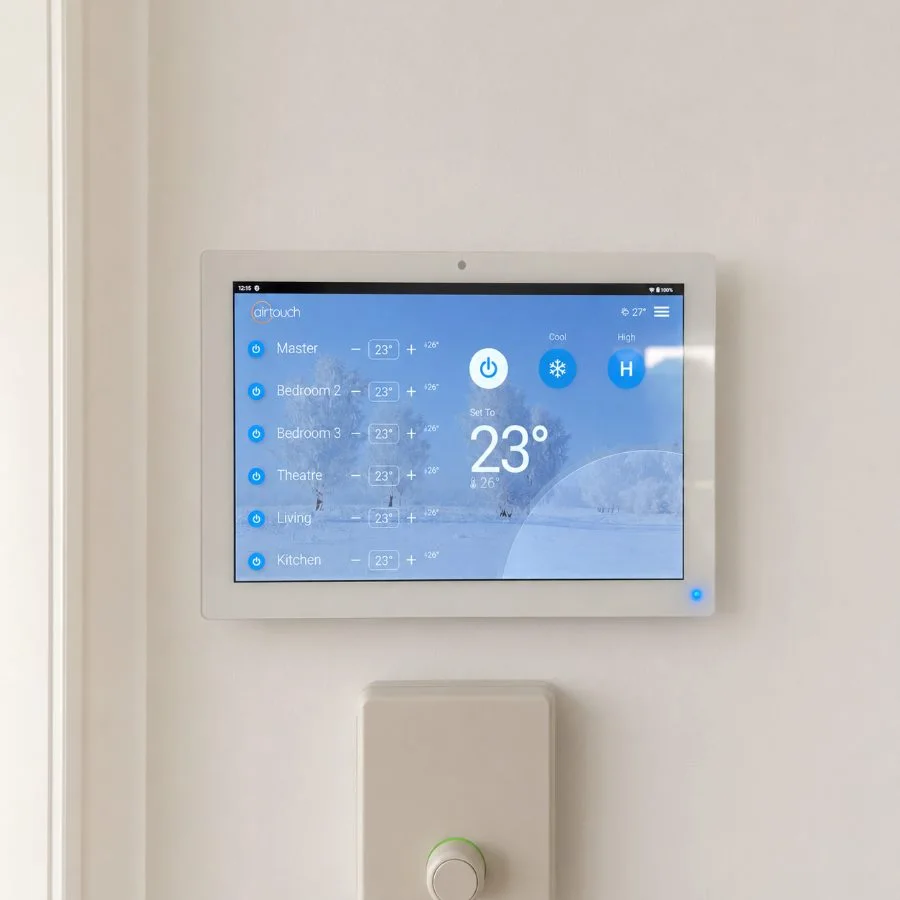
- On ducted, use zoning so you only cool the rooms you're using. See ducted air conditioning.
- Cool the room you're in, not the whole house, with a well-placed split system.
The short version
With Cairns power around 34c/kWh and rising, replacing an old air conditioner with a modern inverter can cut that system's running cost by roughly a third. If your unit is 10+ years old, the upgrade often pays for itself.
Related: How much does air conditioning cost in Cairns? · What size do I need? · Ducted vs split