
A price on its own tells you very little.
Most people comparing three quotes have no way to compare anything except the number at the bottom, because the quotes do not describe what is being installed. The equipment might be listed. The work almost never is.
The difference between two prices usually sits in things that are not itemised, and in things that stop being visible the moment the job is finished. None of that shows up on a one-line quote, and none of it shows up on the day of the install either. It shows up in year three.
This page exists to help you ask better questions. Ask them of Airtek Industries as readily as you ask them of anyone else. A cheaper quote is not a worse quote, but a price without a specification is not something you can compare.
Six things that differ between installations.
Each of these is a real decision someone makes when they price your job. Most of them are invisible once the work is done.
Insulation on the refrigerant pipework
The insulation around the copper pipework does two jobs. It keeps the system efficient, and it stops the cold line sweating and dripping.
What varies is the wall thickness of the insulation and whether it is protected from sunlight. Standard closed-cell insulation is not UV stable. Left in direct tropical sun it hardens, cracks and opens up, usually within a couple of years. Once it splits, the line sweats, the system loses efficiency, and the pipework corrodes underneath. This is the single most common difference between two quotes, and it is almost never itemised.
Capping and how the pipework is run
Capping is the trunking that covers the pipework on an external wall. It is partly appearance, but its real job is keeping sun and weather off the insulation.
What varies is whether capping is included at all, whether it is UV-rated, and how the run is planned. A shorter, tidier run with fewer bends performs better and leaves less opportunity for future faults.
The condensate drain
The indoor unit produces water. In this humidity it produces a lot of it, and where that water goes is a design decision rather than an afterthought.
What varies is the fall on the drain line, where it terminates, and whether the line is insulated where it runs through a roof space. An uninsulated drain in a hot ceiling will sweat, and that water ends up in the ceiling rather than outside.
How the system is prepared before the gas goes in
This is the part nobody sees, and the part that decides how long the system lasts.
Before refrigerant is charged, the pipework has to be free of moisture and contamination. That means brazing the joints correctly, pressure testing, and evacuating the system properly rather than briefly. Moisture left inside a system does not cause an immediate fault. It causes a compressor failure some years later, well past the point where anyone connects it back to the installation.
Mounting, brackets and fixings
What varies is the bracket specification, the fixings used, and how the outdoor unit is secured and positioned.
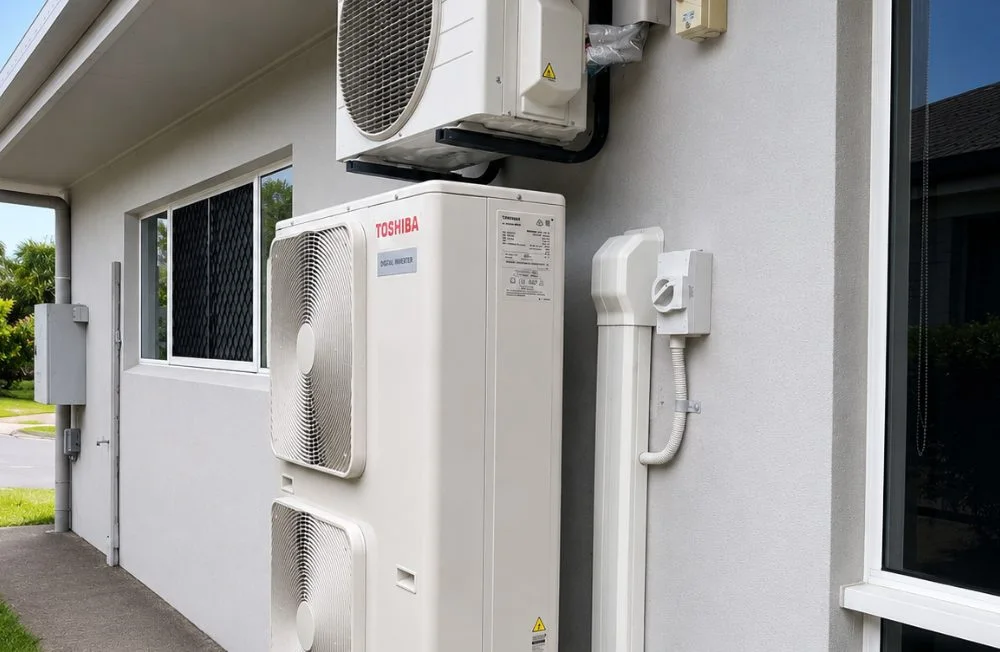
Two local factors matter here. Cairns sits in a cyclone region, so how an outdoor unit is fixed is a genuine consideration. And within a few kilometres of the coast, salt air attacks fasteners and coil fins, so material choice affects how long the unit lasts.
Sizing
What varies is whether anyone calculated the load, or estimated it from the room size.
An undersized system in this climate runs continuously, struggles to pull humidity out of the room, and wears out faster. An oversized one cools quickly, shuts off before it has dehumidified, and leaves the room cold and clammy. Sizing is the decision that most affects whether someone is happy with the system, and it happens before a single tool comes out.
Eight questions to ask any installer.
Put these to whoever is quoting, including us. Each answer explains what you are listening for.
What thickness is the pipe insulation, and how is it protected from the sun?
Ask for the wall thickness in millimetres and how the insulation is shielded from direct sun. Standard closed-cell insulation is not UV stable, so on an exposed external wall it needs capping or a UV-rated covering over it. Without that protection it hardens and splits in the tropics, the cold line begins to sweat, and the pipework corrodes underneath where nobody can see it.
Is capping included, and is it UV-rated?
Ask whether capping is in the price or quoted separately, and whether it is UV-rated. Capping covers the pipework on an external wall and keeps sun and weather off the insulation underneath. A quote that leaves capping out is not necessarily wrong, but it is quoting different work to one that includes it, and that difference should be visible before you compare the two prices.
Where does the condensate drain terminate, and is it insulated through the roof space?
Ask where the water actually goes and what fall the drain line has. An indoor unit produces a large volume of condensate in Far North Queensland humidity. Where the line runs through a hot roof space it needs insulating, because an uninsulated drain sweats and that water ends up in the ceiling rather than outside. Termination point matters as much as the pipe itself.
Will the system be pressure tested and evacuated before charging?
Ask whether the pipework is pressure tested and how long the system is evacuated for. Evacuation pulls moisture and air out of the pipework before refrigerant goes in. Moisture left inside does not cause a fault straight away. It shortens compressor life over several years, long after anyone would connect the failure back to the day of the installation.
What brackets and fixings are being used, and are they suitable for this location?
Ask for the bracket specification and the fixing type, and mention how far you are from the coast. Cairns sits in a cyclone region, so how the outdoor unit is secured matters. Within a few kilometres of the water, salt attacks fasteners and coil fins, so stainless or coated hardware and an anti-corrosion coil option are worth asking about.
How was the size of the system worked out?
Ask what the sizing was based on. Room area alone is a starting point, not a calculation. Ceiling height, insulation, window orientation, glazing and how open the space is all change the load. An undersized system runs flat out and struggles with humidity, and an oversized one cools fast then shuts off before it has dehumidified, leaving the room cold and clammy.
Who is doing the install, and what are their licence numbers?
Ask who will actually be on site and for their licence numbers, then check them on the public registers. Refrigeration work requires an ARC licence and building work in Queensland requires a QBCC licence. Airtek Industries holds QBCC Licence 15619675 and ARC Licence AU61884, and every installation is carried out by our own licensed technicians.
What is covered by the workmanship warranty, and for how long?
Ask what the warranty covers and get the term in writing. Equipment carries a manufacturer warranty, which is separate from the warranty on the installation itself. Ask specifically whether workmanship is covered, for how long, and what happens if a fault turns out to be installation related. Airtek Industries backs every installation with a 10-Year Workmanship Warranty.
What Airtek does.
- Every job starts with a free site inspection, so the system is sized against your rooms rather than estimated over the phone.
- Quotes are itemised, so you can see what the equipment costs and what the installation costs.
- Installations are carried out by our own licensed technicians, and we are happy to walk you through the specification before you decide.
- We answer every question on this page directly. If you want the detail on insulation, capping, drainage or brackets for your job, ask us at the inspection.
Our word is our workmanship.
We stand behind every job.
10-Year Workmanship Warranty
We will walk you through it in person.
Send your details and we will come out, look at the job and go through what is in the quote line by line, ours or anyone else's. Or call 0448 392 019.